



A workplace fall can change an employee’s life in an instant, resulting in serious injury, long-term disability or worse. Beyond the human cost, these incidents take a severe financial, reputational and regulatory toll on companies. While some expenses are immediately visible, many costs remain hidden, compounding over time.
According to the Liberty Mutual 2025 Workplace Safety Index, falls on the same level cost employers over $10.5 billion annually, while falls to a lower level add another $5.8 billion. For industrial facilities, especially, the most effective response should go beyond managing the aftermath and aim to prevent falls entirely. Proactive safety solutions, such as engineered lift systems, provide long-term protection at a fraction of the cost of repeated incidents.
The Visible Financial Impact of a Workplace Fall
When a fall occurs, certain expenses appear immediately on the balance sheet. These direct costs are quantifiable and predictable, but they still represent a significant financial burden. Understanding these visible expenses is the first step in grasping the true cost of workplace fall incidents.
Direct Medical and Workers’ Compensation Costs
The immediate financial impact begins the moment an employee gets injured. Direct medical expenses alone can include:
- Emergency medical care
- Hospitalization
- Surgery
- Physical therapy
- Ongoing treatment
Beyond these medical expenses, workers’ compensation claims cover indemnity payments, or the wages lost while the employee recovers.
According to the National Safety Council, the average cost of a medically consulted injury is approximately $43,000. This figure reflects only the direct medical and indemnity costs. For falls resulting in fractures, spinal injuries or traumatic brain injuries, expenses can be even greater. Workers’ compensation premiums absorb much of this burden, but the impact doesn’t end when the claim closes.
Cost of OSHA Fall Protection Violations
Regulatory fines add another layer of financial exposure. OSHA treats fall protection violations seriously, and penalties have increased to reflect that priority. Following the 2025 penalty adjustments, serious and other-than-serious violations can cost over $16,000 per citation. Willful or repeated violations carry penalties up to $165,514 per incident.
For facilities with multiple fall hazards or repeat violations, these fines compound quickly. A single OSHA inspection following a fall incident can result in citations across multiple work areas, turning a $16,550 penalty into a six-figure regulatory expense. These costs are entirely uninsured and come directly from operating budgets.
The Hidden Costs of Industrial Fall Incidents
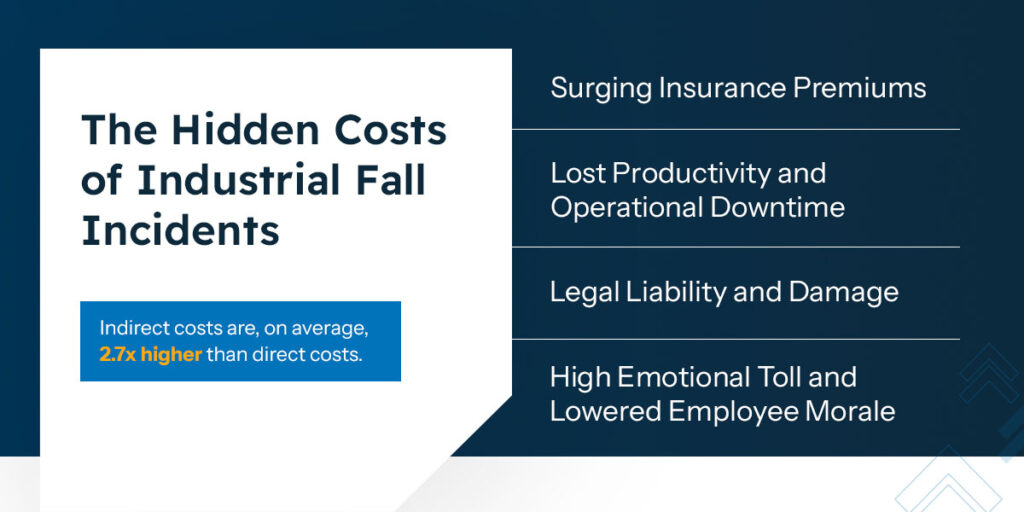
The true financial burden of a fall extends far beyond the initial claim and citation. Indirect costs are, on average, 2.7 times higher than direct costs. These hidden expenses accumulate slowly, making them harder to track but no less damaging to the bottom line.
Surging Insurance Premiums
A single severe fall generates a workers’ compensation claim and impacts your Experience Modification Rate (EMR), the metric insurers use to calculate premiums. A higher EMR directly translates into higher insurance costs, and those increases persist for years.
For example, a facility with a baseline EMR of 1.0 might see that figure rise to 1.2 or higher following a serious injury. On a $500,000 annual workers’ compensation premium, that would mean a 20% increase, adding $100,000 per year. If the incident triggers litigation, general liability premiums may rise as well, compounding the financial strain.
Lost Productivity and Operational Downtime
Losing an experienced worker disrupts operations immediately. The injured employee’s absence creates a workflow gap, forcing co-workers to take on additional responsibilities or work overtime. Temporary labor may fill the role, but new hires require training, supervision and time to reach full productivity.
For facilities engaged in manufacturing and production, downtime on the assembly line translates to:
- Missed production targets.
- Delayed shipments.
- Dissatisfied customers.
- Financial liabilities.
- Spoiled products.
Recruiting, hiring and onboarding a replacement, whether temporary or permanent, adds other costs:
- Recruiting fees
- Training costs
- Administrative overhead
- Legal fees
According to the University of Tennessee Center for Industrial Services, turnover costs for hourly manufacturing employees average 16% of their salary.
Legal Liability and Reputational Damage
Beyond OSHA fines and insurance claims, severe fall incidents can trigger extended legal action. Employees may pursue third-party liability claims, particularly if equipment failure or contractor negligence contributed to the fall. Legal fees, settlements and potential judgments add costs that insurance may not fully cover.
Workplace fall liability also carries reputational consequences. News of a serious incident spreads quickly, particularly in tight-knit industrial communities. Prospective employees research safety records before accepting offers, and companies with poor safety reputations struggle to attract and retain top talent. For facilities bidding on contracts, a damaged safety record can disqualify you from consideration or require costly additional bonding.
High Emotional Toll and Lowered Employee Morale
In addition to injured personnel, falls affect the entire workforce. When employees witness a colleague seriously injured, trust in facility leadership erodes. Workers begin questioning whether management prioritizes their safety, and that skepticism lowers engagement, productivity and retention. Low morale manifests in measurable ways:
- Increased absenteeism
- Higher turnover
- Reduced discretionary effort
- Reluctance to report hazards if management did not take action on past reports
These cultural consequences compound the financial damage, creating a cycle in which poor safety outcomes reinforce a poor safety culture, driving indirect costs even higher.
Shifting From Reactive Liability to Proactive Fall Prevention
The costs outlined above share a common thread — they are all reactive. Every dollar spent on medical care, legal fees and insurance premiums addresses a fall that already happened. The smarter financial strategy focuses on eliminating fall hazards before they generate injuries, claims and regulatory scrutiny.
Investing in engineered safety solutions, such as standard lift solutions or custom lift systems, mitigates the hazard. Workers gain stable, ergonomic access to elevated work areas without relying on ladders, scaffolding or other temporary platforms that introduce unnecessary risk. The up-front capital investment is substantial, but it’s significantly cheaper than absorbing the cumulative cost of even a single serious fall.
Evaluating the Financial ROI of Engineered Safety Solutions
OSHA provides a calculator to help facilities quantify the financial impact of workplace injuries. The tool demonstrates the critical reality that, after an injury, businesses must generate massive additional revenue just to break even.
Consider a single fracture injury. Based on OSHA’s estimator, the direct cost averages $54,856, while indirect costs add another $60,341, bringing the total cost to $115,197.
For a company operating at a 3% profit margin, covering that expense requires an additional $3,839,900 in sales. That’s nearly $4 million in new revenue to offset the cost of one preventable injury. When you scale these costs across multiple incidents, few facilities have the necessary revenue cushion to remain profitable, which is why prevention delivers such a compelling return on investment.
Replacing ladders and temporary access methods with engineered lift platforms, such as scissor lifts and overhead and suspended lifts, eliminates the root cause of many fall hazards. The one-time investment prevents incidents that could cost millions in cumulative exposure over time.